
New Developments in Bizen – The Case of Koichiro Isezaki
In Japan there is a type of pottery known as ‘yakishime’, meaning ‘fire-sealed’ or ‘kiln sealed’. Yakishime is fired at very high temperatures to densify the clay so — intriguingly — it is watertight even without the application of a vitreous glaze. Unlike porcelain, earthenware clays tend to be fragile and porous, so they are usuallyavoided for food and drink vessels. However, yakishime has been used for tableware in Japan since the middle ages, which apparently met with disbelief in the West.

Yakishime has a long history – Shigaraki and Tokoname Ware examples are well known – and Bizen Ware is virtually synonymous with this type of pottery; Bizen yakishime pots, with their gorgeous decorative fire-cord marks and earthy auburn highlights, are produced mainly in the Imbe region of Okayama Prefecture. So Bizen and other regions created pottery using local clays and local wood as fuel for the kilns, and each type of ware was named after its area of production.
The pots were then transported and sold further afield, allowing these areas to develop as ceramics production centres. These regions are well-known and continue to flourish today, as the availability of tool suppliers, the existence of educational institutions and so on, created an environment conducive to pottery-making, and draw more ceramic artists to locate there. However, today’s pottery- making differs from historic production in that with the development of distribution networks, many ceramic artists no longer use local clay, and often fire their work in electric or gas kilns instead of traditional wood-fired ones.

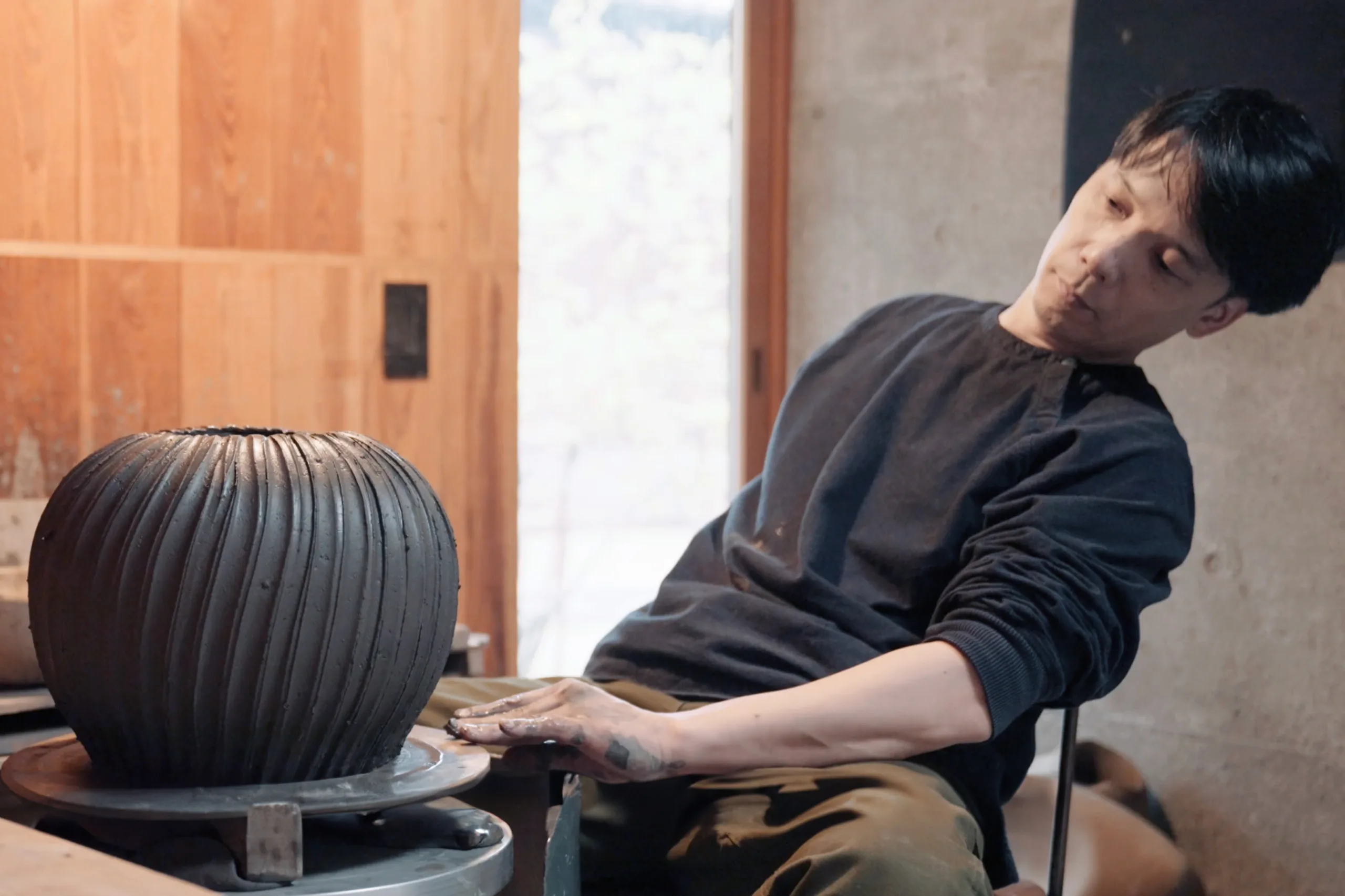
Nevertheless, Koichiro Isezaki and other Bizen potters still make their work from clay collected from the area where they live, and fire it using traditional methods. For Isezaki in particular, this is an integral part of his creative process. Ceramic artists often incorporate the concept of ‘trusting in the process’ into their work, expressed in phrases like ‘dialogue with the clay’, ‘being guided by the potter’s wheel’, and ‘surrendering work to the kiln’. But this ‘hallowed space’ is only accessible because it is grounded in the maker’s long experience and technical skills – skills born of a finely-honed sensibility and understanding of the fundamental principles of the natural world, that coexist with, rather than conquer, nature.

Most of Isezaki’s pieces are either functional vessels, such as tea bowls and flower vases, or sculptural objects which have an opening. To him these are all three-dimensional forms, where the opening does not signify the top of the piece, but rather the interface between the work and the space. We can see this as a device which the artist uses to express the historically important idea that Japanese crafts exist within daily life, within our daily living-space. Nowadays, Japanese traditional crafts are highly regarded overseas. The reason lies in their beauty and delicacy, achieved through painstaking attention to detail and also, I believe, in the national cultural identity that has passed these traditions down through generations. Isezaki and his work are no exception; he works within the Bizen tradition, creating new sculptural vessels that resonate with people today. They are works of art that combine beautiful forms with gorgeous evocative surfaces.
Mieko Iwai, Head of the Craft Department National Craft Museum, Kanazawa, Japan.

備前焼の新展開‐伊勢崎晃一朗の場合‐
焼締というやきものがある。言葉どおり高温で土を焼き締めることで、ガラス質の釉薬がかかっていないにも関わらず、水漏れしない不思議なやきものだ。一般的に石ものと言われる磁器より土ものといわれる陶器は、脆く水を通してしまうため食の器として敬遠されがちな傾向がある。しかし日本では中世よりこの焼締を食器として使用してきたが、欧米の人々にとっては長く信じられないものだったそうだ。焼締は長い歴史を持つやきもので、信楽焼、常滑焼などが良く知られているが、なかでも岡山県の伊部地域を中心に制作されている備前焼はその代名詞のような存在で、緋襷や牡丹餅といった模様が人々を魅了している。この備前焼をはじめ、〇〇焼と呼ばれるやきものは、その地の土を使用し木を薪として窯を炊き、各地へ輸送し販売され、その地域は産地として発展した。翻って現在、その地域は道具屋や教育機関が充実しているため作陶の環境が整っており、陶芸家が集いやすく変わらず産地として知られているが、古の産地と異なるのは流通網の発達により、その地の土を使用せず電気やガスを燃料とする窯で焼成する陶芸家が多い点である。しかし伊勢崎晃一朗をはじめとした備前の作家は今でも自分の住まう地で採取する土を用い、伝統的な焼成方法によって制作している。なかでも伊勢崎にとってそれらは一体となった制作行為であるのだという。陶芸家は「土との対話」「ろくろが導く」「窯にまかせる」といったように、制作工程に「まかせる」という概念を持ち込む者が多い。しかしそれは作り手の長い経験と技術が根底にあるからこそ、可能な聖域だろう。それは、自然の摂理を知ることで征服するのではなく共生することと似た感覚であり、研ぎ澄まされた感覚による技術である。
伊勢崎の作品は、茶碗や花器といったいわゆる器と口を備えた彫刻的なフォルムのオブジェ作品が多い。彼にとってはいずれも立体造形物であり、作品の口は上部を意味するのではなく、空間との接点と考えているという。これは日本の工芸は生活(空間)のなかにあるという歴史的で重要な視点を作品で表現する思考の技術といえよう。
昨今、日本の伝統工芸が海外で高い評価を受けている。その理由は丁寧さや繊細さといった手間ひまをかけた美しさにあり、加えてそれを伝統として受け継いできた国民性も関係しているのだろう。伊勢崎やその作品も例外ではなく、備前の伝統のなかで今を生きる人々の共感を得られるよう新しい造形として表出される。それは美しい景色を備えた美しい造形の芸術なのだ。
国立工芸館工芸課長 岩井美恵子(いわいみえこ)
Translation by Martie Jelinek